


Last Updated: October 25, 2026
Quick Summary
Treat cracked dog pads naturally by cleaning paws with lukewarm water, then applying a pet-safe balm built on a barrier like beeswax plus a moisturizer such as coconut oil. Minor cracks usually improve within three to seven days of consistent care, while deep cracks can take two to four weeks.
- Soak crusty paws in lukewarm water with a small scoop of Epsom salt for three to five minutes.
- Avoid balms containing zinc oxide, essential oils, fragrance, dye, or xylitol.
- Apply balm at bedtime and cover the paw with a loosely taped baby sock to stop licking.
- Rinse paws after every winter walk to remove road salt and ice.
- See a vet promptly for bleeding cracks, swelling, pus, or limping.
Table of Contents
- Why Dry, Cracked Dog Pads Happen: Causes of Cracked Dog Paw Pads
- How to Clean Dog Paws Without a Bath Before You Treat
- Natural Remedies for Cracked Dog Paws That Are Safe to Lick
- A Step-by-Step Treatment Schedule With Realistic Healing Times
- Dog Paw Pad Infection Signs and When to See a Vet
- Preventing Cracks: Seasonal Paw Care for Salt, Ice, and Hot Pavement
- Build a Daily Paw Care Routine With a Gentle Spray
- Frequently Asked Questions
Why Dry, Cracked Dog Pads Happen: Causes of Cracked Dog Paw Pads
The causes stack up fast. Rough surfaces like hot pavement, gravel, and ice crystals wear the pad down. Road salt and de-icing chemicals pull moisture out of the skin.
The PetMD guide to cracked dog paws points out that treatment depends on the underlying cause. That matters. A dog whose pads crack every few months may have more going on than dry weather.
Watch out: if cracks keep coming back in the same spots, the problem is usually environmental or medical, not a missing balm.
How to Clean Dog Paws Without a Bath Before You Treat
Clean paws first. A balm applied over road salt, grit, or bacteria seals the irritant against the skin instead of helping it.
Here's how to do it:
- Fill a shallow basin with lukewarm water, not hot
- Add a small scoop of Epsom salt for a gentle soak if paws are crusty
- Stand the dog in the basin for three to five minutes
- Wipe each pad with a soft cloth, working between the toes
- Dry thoroughly, especially between the pads, before applying anything
Skip the shampoo. Harsh soaps strip the oils the pad needs to heal. A plain water rinse handles most everyday grime.
For a dog that hates baths, a damp cloth and a bowl of water work fine. The goal is gentle cleaning, not a full groom.
Natural Remedies for Cracked Dog Paws That Are Safe to Lick
The best natural remedies for cracked dog paws are simple moisturizers that soften the pad, support healing, and won't harm a dog that licks its feet afterward.
Veterinary guidance from the Onion River Animal Hospital warns that some over-the-counter products contain ingredients that are safe for people but harmful to pets. That's the single most important filter when you shop. Below is how the common natural ingredients actually compare, including the trade-offs most balm labels don't mention.
Ingredient-by-Ingredient Safety and Evidence
Beeswax, A occlusive barrier that seals moisture into the pad and keeps irritants out.
Coconut oil, Softens pads and contains lauric acid, which has mild antibacterial and antifungal activity in lab settings.
Grapeseed and almond oils, Light carrier oils that absorb fast and are low-irritation for most dogs.
Vitamin E, An antioxidant that supports skin repair.
Lanolin, Conditions deeply cracked pads and holds moisture well. It is derived from sheep wool, so it can carry trace allergens; dogs with sensitive skin may react.
Petroleum jelly, A cheap, effective short-term barrier.
Shea butter and cocoa butter, Rich moisturizers that are generally well tolerated.
Ingredients to Avoid
- Zinc oxide, Found in many human diaper creams, it can be toxic if licked in quantity and is a common cause of GI upset in dogs.
- Tea tree oil and other essential oils, Concentrated essential oils, especially tea tree, peppermint, and eucalyptus, are risky for dogs and can cause drooling, vomiting, and neurological signs if ingested.
- Fragrance and dye additives, Irritate sensitive skin and add no therapeutic value.
- Human hand creams, Often contain ingredients dogs shouldn't ingest, including some of the above.
- Xylitol-containing products, A sweetener that is severely toxic to dogs; check labels on any flavored balm.
How to Choose a Dog-Safe Balm
Look for a short ingredient list built around a barrier (beeswax, lanolin, or petroleum jelly) plus a moisturizer (coconut or grapeseed oil). Avoid products that list essential oils, fragrance, dye, or zinc oxide. If your dog has allergies, introduce one new product at a time and watch for redness or licking at the application site for 24 hours before using it on all four paws.
A patch test on a single pad is the cheapest safety check you can run. Apply a small amount, wait a day, and check for irritation before committing to a full routine.
A Step-by-Step Treatment Schedule With Realistic Healing Times
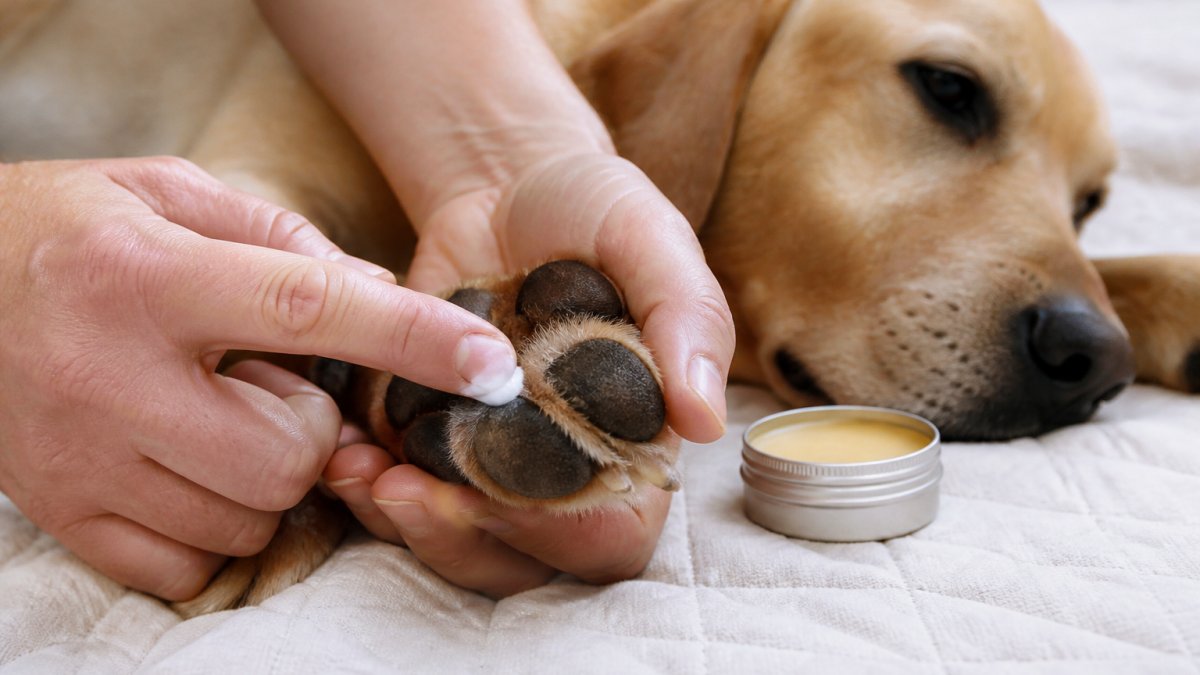
Minor cracks usually improve within three to seven days of consistent care. Deep cracks that bleed or split open take longer, often two to four weeks, and need a vet's input.
Here's a schedule that works:
| Day | Action | What to Expect |
|---|---|---|
| Day 1 | Clean, dry, apply balm, cover with a sock | Pad looks softer within hours |
| Days 2-3 | Clean and reapply balm twice daily | Cracks begin to close at the edges |
| Days 4-7 | Reapply once daily, limit rough walks | Minor cracks mostly healed |
| Weeks 2-4 | Maintain daily moisture, protect outdoors | Deep cracks fill in gradually |
A few practical notes. Apply balm at bedtime so the dog isn't walking it off. A baby sock taped loosely around the paw keeps product in place and stops licking.
If a crack gets worse instead of better after a week of care, stop guessing and call your vet.
Dog Paw Pad Infection Signs and When to See a Vet
A paw pad infection is a bacterial or fungal overgrowth in damaged pad tissue, and it needs treatment a balm can't provide. Dryness alone rarely causes infection, but cracked pads are an open door. The harder question for most owners is where home care ends and a vet visit begins. Use this triage guide to sort the situation before you reach for another balm.
Triage: Minor Dryness vs. Urgent Symptoms
Green, home care is reasonable:
- Pads feel rough, dry, or slightly flaky
- Shallow surface cracks with no bleeding
- No limping, swelling, or odor
- Dog is comfortable walking and not obsessively licking
Yellow, home care for a few days, then call the vet if no improvement:
- Cracks that are visible and slightly deeper but not bleeding
- Mild redness at the crack edges
- Occasional licking at one paw
- No change after 5-7 days of consistent cleaning and moisturizing
Red, see a veterinarian promptly:
- Cracks that bleed or split open
- Swelling, heat, or redness spreading across the pad
- Pus, discharge, or a bad smell
- Limping or refusing to walk
- Persistent licking or chewing at one paw
- Hair loss around the paw
- Slow wound healing or recurrent infections
- Cracks that return every few months in the same spots
What a Vet Will Look At
The PetMD guidance notes that treatment may include pain medication or antibiotics alongside moisturizing care. That's the escalation point. Cracks that bleed, won't close, or come with any of the signs above need a veterinarian, not another balm.
A vet will typically check for infection, look at the gait and nail length, and ask about diet, allergies, and environment. Some dogs develop cracked pads because of an underlying issue like zinc deficiency or a hormonal condition. If cracks return every few months, ask your vet to look at the whole picture rather than treating the surface each time.
Why Cracks Keep Coming Back
Recurring cracking usually points to one of four drivers: an environmental exposure you haven't removed (salt, hot pavement, rough gravel), an allergic or irritant contact reaction, a low-grade infection that never fully cleared, or a nutritional or hormonal issue. A balm can manage the symptom, but it won't fix any of these. If you have treated consistently for two to four weeks and the pads are still cracking, the next step is a veterinary assessment, not a stronger balm.
Preventing Cracks: Seasonal Paw Care for Salt, Ice, and Hot Pavement
Prevention beats treatment every time, and it changes with the season.
Winter: Road salt and ice are the biggest threats. Rinse paws after every walk. Keep paw hair trimmed short so salt doesn't cling.
Summer: Hot pavement burns pads fast. Test the ground with the back of your hand for five seconds. If it's too hot for you, it's too hot for paws.
Year-round: Keep pads moisturized, avoid gravel-heavy routes on very dry days, and check paws after every hike or park visit.
A simple paw protectant routine, rinse, dry, moisturize, takes two minutes and prevents most cracking before it starts.
Build a Daily Paw Care Routine With a Gentle Spray
The easiest routine is the one you'll actually keep. For us, that means a quick clean-and-protect step after every outdoor trip, not a weekly deep treatment.
A gentle daily spray fits that rhythm. e11ement Pet offers a hypochlorous acid spray that uses the same molecule your pet's immune system produces naturally.
Watch out: don't spray and immediately let the dog walk on treated floors. Hypochlorous acid is gentle, but a wet paw is a slippery paw.
Pair the spray with a dog-safe balm and a two-minute check after every outing. That's the whole routine, and it's enough to keep most paws healthy through every season.
Frequently Asked Questions
How can I treat my dog's dry, cracked paw pads naturally?
Start by cleaning the paws with a gentle, pet-safe spray and drying them fully. Apply a thin layer of a vet-approved balm containing ingredients like beeswax, coconut oil, or vitamin E, then keep your dog off rough surfaces while it absorbs. Repeat once or twice daily. PetMD notes that treatment depends on the underlying cause, and even a small crack may benefit from a moisturizer or protective agent to prevent worsening. If cracks are deep, bleeding, or not improving within a week or two, book a vet visit.
Is coconut oil safe for dogs' paw pads if they lick it?
Small amounts of food-grade coconut oil are generally considered safe if a dog licks it, but it is not a complete treatment on its own. It can soften dry pads and add a light moisture barrier. Apply a thin layer and distract your dog for a few minutes so some absorbs. Onion River Animal Hospital cautions that some over-the-counter products contain ingredients safe for people but harmful to pets, so check labels and choose a vet-approved balm or moisturizer rather than a human hand cream.
How do I know if my dog's cracked paw pads need veterinary care?
See a vet if you notice signs of dog paw pad infection: redness, swelling, pus, a bad smell, constant licking, limping, or cracks that bleed. PetMD notes that treatment may include pain medication or antibiotics depending on the cause, which you cannot get from a home balm. Also call your vet if dryness does not improve after one to two weeks of consistent care, or if your dog has recurring cracks, slow wound healing, or hair loss, which can point to an underlying issue such as zinc deficiency.
How long do cracked dog paw pads take to heal?
Minor cracks and dryness often improve within one to two weeks of daily cleaning and moisturizing, though healing depends on the cause and severity. Deep cracks, infections, or cracks linked to an underlying medical condition take longer and need veterinary treatment. Keep walks on soft surfaces, avoid road salt and hot pavement, and clean paws after outdoor time. If you see no improvement after two weeks, or the pads get worse, have your vet examine them.
Dry, cracked paws are easy to ignore until your dog starts limping. The fix is consistency: clean paws after every walk, moisturize with a lick-safe balm, and know the signs that mean a vet visit. e11ement Pet's hypochlorous acid spray supports daily paw, skin, and coat care with a gentle formula made in Canada. Get started with e11ement Pet and give your dog a paw care routine that actually fits your day.


